
The list is in front of you — the whole load, seen and priced.
Every item on it has been named without judgment. Every item has been weighed honestly: what it costs in time, energy, attention, money, and support, what it costs before and after, and what it costs the things that did not happen instead. And the hardest confusion has been set down — the idea that anything important must be happening now, all at once, or not matter at all.
So the practical question is the one left standing, and it is a plain one: what happens to each of these things?
Not to the list as a whole. To each thing on it, one at a time. That is where deciding actually happens, and it is what this article is for.
Deciding Is Not a Sweep
After all the seeing and weighing, it is tempting to want the deciding to be quick — one honest afternoon, one clean pass down the list, done. A sweep has a certain appeal. It feels decisive.
But a load was not built in a sweep, and it will not be honestly decided in one either. Each thing on that list arrived for its own reasons, carries its own cost, and makes its own kind of claim. A responsibility is not decided the way an expectation is decided. A personal priority is not decided the way a real-but-not-yet thing is decided. Deciding them in a single motion, with a single mood, treats them as if they were all the same kind of thing — and they are not.
Deciding is slower and smaller than that. It is one item, given its own honest moment. What is this? What does it cost? Whose claim is it, really? And then — only then — what happens to it?
There is one more thing to name before the decisions themselves, because it quietly shapes all of them: refusing to choose is also a choice. The ordering that already exists — the one set by whoever asked loudest, whatever arrived first, whatever felt most urgent — does not pause while we avoid deciding. It simply goes on deciding for us. Every item left unexamined is, in effect, being carried exactly as it is, at its full price, by default.
The decisions that follow are how the ordering becomes deliberate instead.
Five Decisions
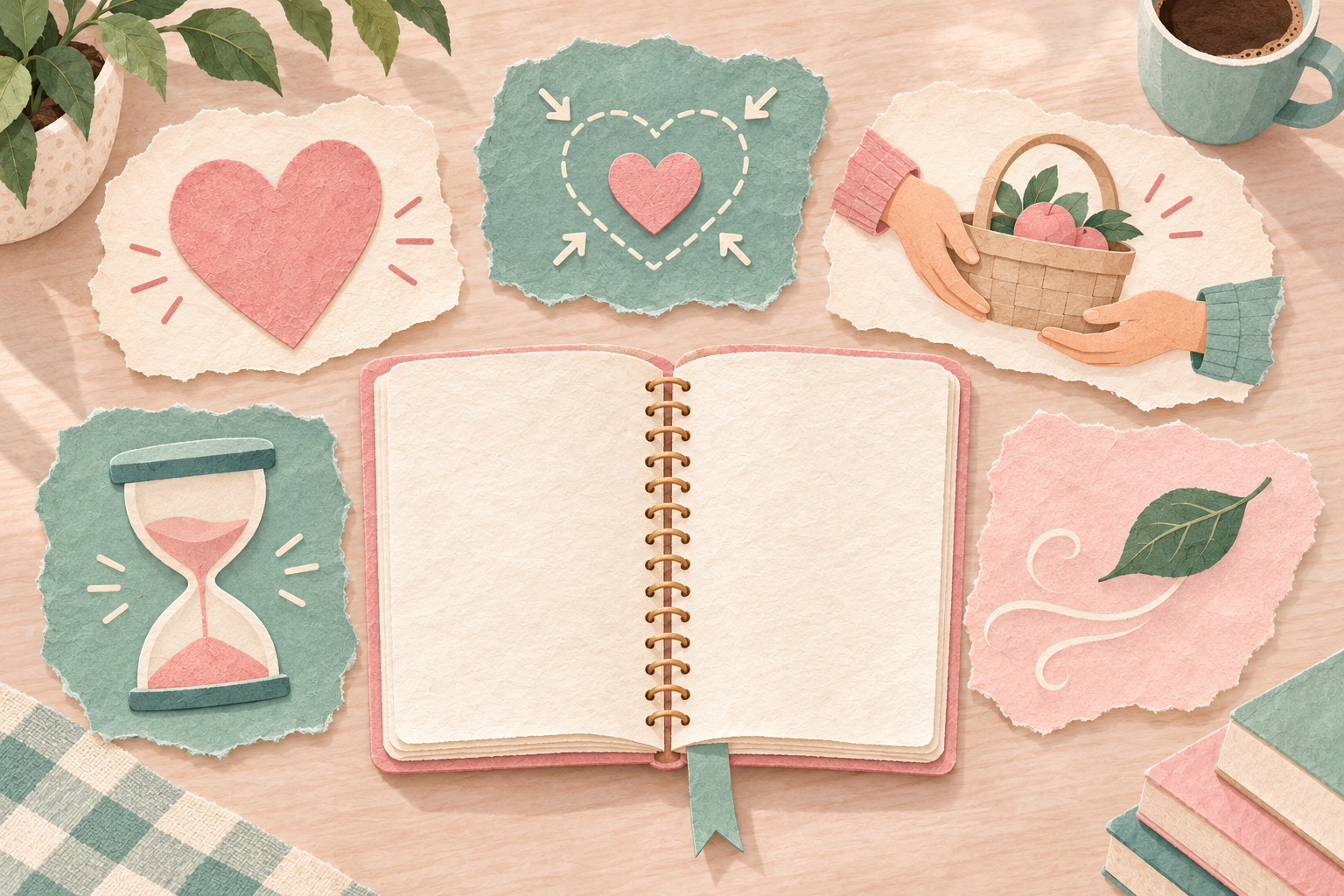
Here is the whole of it, plainly: every item on the list gets one of five decisions.
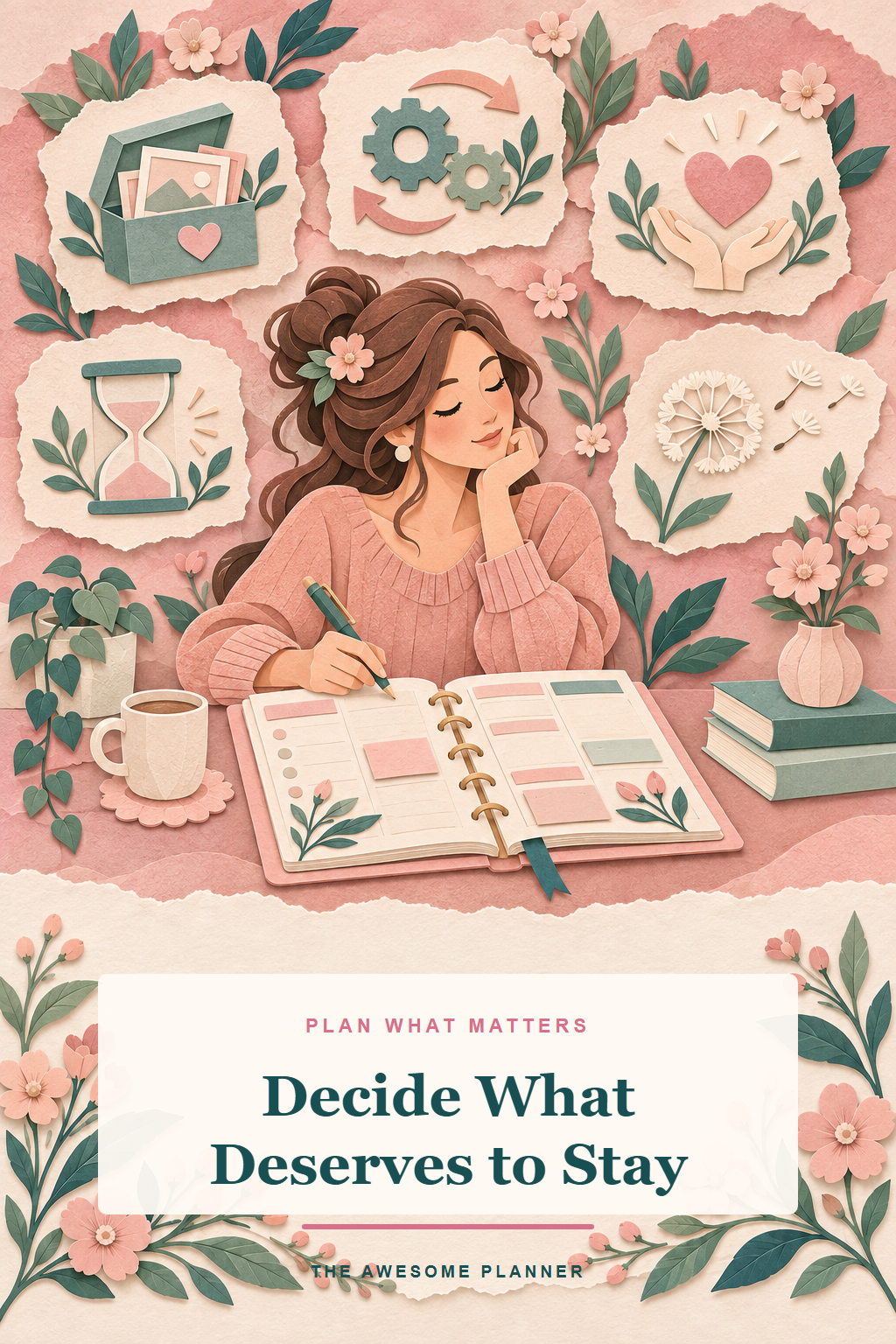
Keep. Change. Share. Wait. Let Go.
That is the complete set. There is no sixth thing that happens to a commitment — anything we carry is being kept, changed, shared, waited on, or let go, whether we chose it or not. The work of this article is simply to make each of those a decision: looked at, priced, and chosen on purpose.
None of the five is the good decision and none is the bad one. Each is right for some items and wrong for others, and the same life will honestly use all five. What follows is what each one actually means — because several of them are widely misunderstood, and one of them is the option most people never see at all.
Keep — Chosen, Not Defaulted
Some things stay.
They stay as they are, carried at the full cost they were priced at, because they are worth it and because this is their season. A responsibility that is genuinely ours and genuinely now. A piece of work or care that we have looked at with open eyes and would choose again.
Keeping sounds like doing nothing, and for an unexamined item, that is exactly what it is. But a kept thing is different from an unexamined thing, and the difference matters. The unexamined thing is carried by momentum — it is in the load because it has always been in the load. The kept thing has been seen, weighed, and chosen. It stays on purpose.
That difference shows up on the hard days. A commitment that was chosen can be carried differently from one that merely accumulated, because we know why it is there and what it costs and that we said yes with the whole price in view. Keep is a decision. For the right items, it is the strongest one on the list.
Change — the Middle Option People Forget
Some things stay — at a different size.
This is the decision that disappears when we think the only choices are all or nothing. Faced with a commitment that costs too much as it stands, we imagine the alternatives are to carry it exactly as it is, forever, or to abandon it entirely. Many people live squeezed between those two options for years, exhausted by the first and unwilling to do the second, never seeing the one that was available the whole time.
A thing can stay in a life at a different size: less often, smaller, simpler. At a human standard instead of a perfect one. With some of its edges — the preparation, the extras, the parts that cost the most and matter the least — honestly trimmed away.
Changing the shape of a commitment is not failing it, and it is not breaking faith with it. The thing itself — the care, the work, the responsibility underneath — is still being honored. What has changed is its size, so that it fits inside a real life alongside everything else that life is carrying. For a great many items on a real list, this is the honest decision: not kept as-is, not released, but resized to something a person can actually carry well.

Share — Not Carried Solo
Some things stay — in more hands than ours.
The load was never required to be carried solo, though it is remarkable how completely we can believe that it was. Item after item sits on the list as if our hands were the only ones that exist, and we weigh each one as a solitary cost because it has never occurred to us to weigh it any other way.
Sharing is the decision to change who carries a thing: handed over to someone better placed for it, split between hands, or simply asked for help with, out loud, on purpose. It is worth remembering that support was one of the five currencies a commitment can cost. Sharing is where that currency gets spent deliberately — by us, in the direction of our own load, instead of only ever being spent by others on theirs.
Of the five decisions, this is the hardest for many people to make, and it is worth being honest about why. Sharing requires admitting the load is real — that it is more than one person should carry — and admitting it to another person, who might see it differently than we hoped. Keeping everything in our own hands can feel like strength. Often it is only privacy. A shared thing has not been judged less important. Sharing is a decision about who carries it, not about whether it matters.
Wait — a Place in Line
Some things wait — on purpose, in a named place.
Waiting has already been given its ground: a thing can matter deeply and still not belong to this season, and "not now" is a statement about sequence, not a verdict on worth. Here, waiting takes its place as a decision — something done deliberately, not something that merely happens to the items we never got around to choosing.
That distinction is the whole of it. A drifted thing sits in a guilty corner of the present, half-carried and wholly resented, taking up attention it was never honestly assigned. A waited thing has been placed. It is named. It is honored. It has a real position in line, to be picked up when its season comes — and until then, it is not being carried at all. It is being kept, the way a garden bed is kept over winter: not worked, not abandoned, simply held for its season.
Waiting is how a life says yes across time instead of all at once. For the real-but-not-yet things especially — the ones that are ours, that matter, whose season has not arrived — it is not the disappointing decision. It is the one that protects them from being carried badly now and dropped entirely later.
Let Go — Named Honestly
And some things are released entirely.
Letting go means a thing will not be carried anymore — not resized, not shared, not waited on. Ended. It is important to say plainly what that is and what it is not. It is not a verdict that the thing never mattered; many released things mattered a great deal, and some were carried for years with love. It is not a failure, either. A life that can only add and never release is not a committed life. It is an overloaded one, and eventually it carries everything badly, including the things that matter most.
Some of what gets released deserves a clear eye: the expectations that were never really ours, the obligations nobody needs anymore, the plans a younger self made that the current self never re-approved. Others are harder. It would be dishonest to pretend that letting go never aches — for some items it will, and the ache does not mean the decision was wrong. How to be at peace with the released things — the guilt, the grief, the pull to take them back — is real work. Here, Let Go simply takes its honest place among the five: a decision some items are owed.
A Chosen Load
When every item on the list has its decision, something has changed — even if, from the outside, the load looks similar. Items were kept, and they were kept on purpose. Items were changed to a size a life can hold. Items were shared into more hands. Items were waited, placed in line with their names on them. Items were let go, honestly, and are no longer being paid for.
What remains is a chosen load.
It is sized, at last, by decision rather than by accumulation. That does not make it light — a chosen load can still be full, and demanding, and costly in all five currencies. But every part of it is there because it was looked at and chosen, and nothing in it is being carried by accident, by loudness, or by default.
Making the decisions is one thing. Being at peace with them — especially the ones that mean releasing something that mattered — is another part of the work. For now, a chosen load begins with seeing each decision clearly and making it on purpose.
Related reading: Important Doesn't Always Mean Now and Everything Has a Cost.